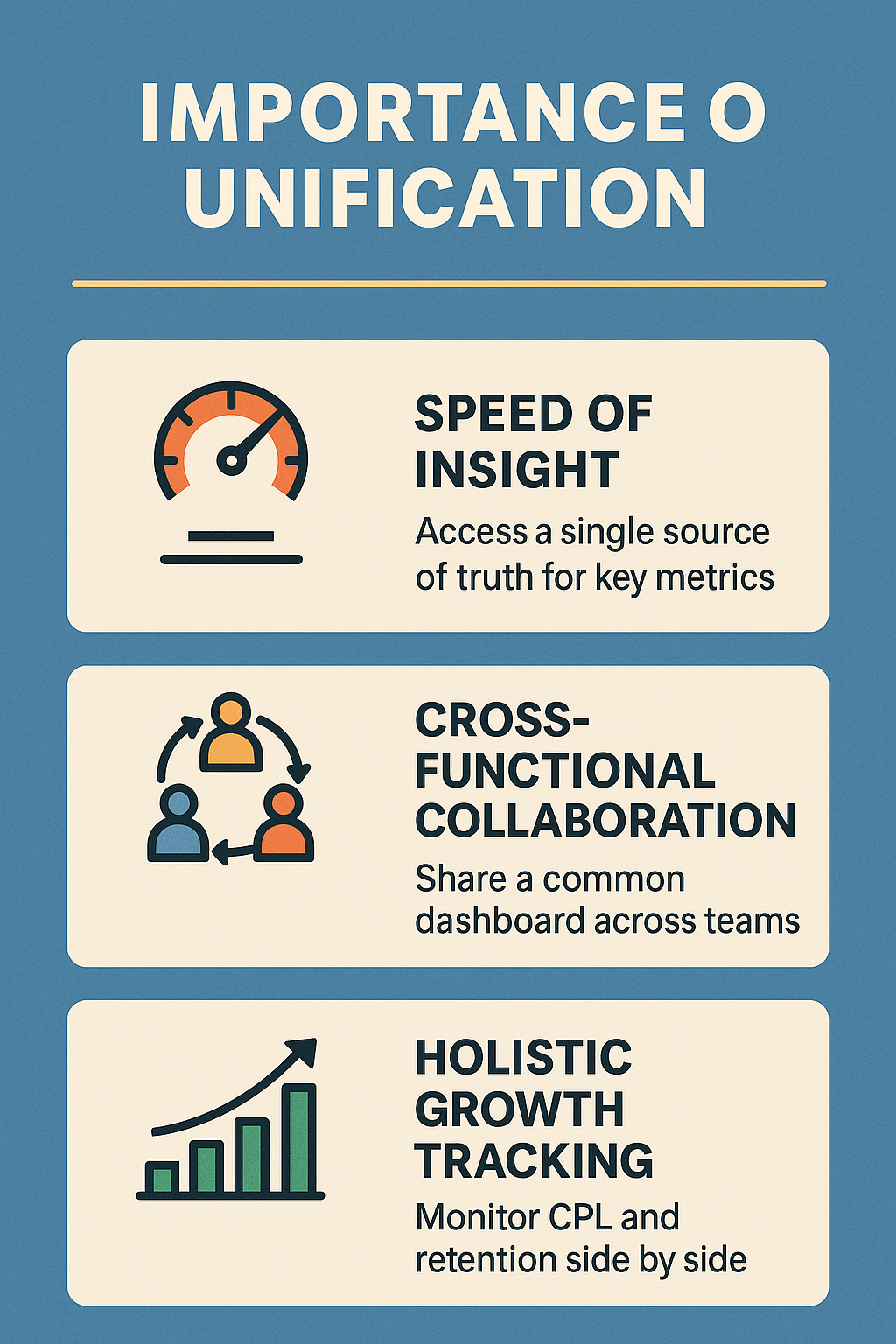
In this data-centric age, separate reporting is the imperceptible destructor of growth. Marketing departments are treading between different platforms—Google Analytics, CRM systems, and product-management tools. Sales decision-makers are lost in spreadsheets and BI suites. Support teams are submerged in ticketing dashboards. What is the achieve Wi? Diverse perspectives, confusion in analysis, and lost chances. With an all-in-one analytics solution, all essential indicators—cost-per-lead (CPL) to retention—are there in a unified view, making it easy to choose, agree, and influence.
1. Importance of Unification
- Speed of Insight
When the team calls “What’s our natural CPL?” or “How does retention behave?” they really need a single source of truth. A unified KPI dashboard trucking SaaS platform puts the end of guesswork and provides real-time answers. - Cross-Functional Collaboration
Marketing, sales, product, and customer-success teams are sharing the same dashboard, ensuring that the understanding is the same. Alignment, in turn, leads to the more rapid cycle of experimentation and iteration. - Holistic Growth Tracking
Trying to lower CPL is meaningless if the retention rate decreases. By placing CPL to retention metrics next to each other, you will be able to see trade-offs earlier and optimize the customer journey from prospect acquisition to long-term loyalty.
2. Core Metrics Determining

Before building an integrated dashboard, clarify which numbers truly drive your business. While exact definitions vary across industries, the following metrics form the foundation for most SaaS organizations—trucking-focused or otherwise.
| Metric | Definition | Why It Matters |
| Cost-per-Lead (CPL) | Total marketing spend ÷ number of qualified leads generated | Measures acquisition efficiency |
| Lead Conversion Rate | Qualified leads ÷ total website/app visitors | Tracks the performance of your landing pages |
| Customer Acquisition Cost (CAC) | Total sales & marketing spend ÷ number of new customers | Captures full cost of winning a customer |
| Monthly Recurring Revenue (MRR) | Sum of monthly subscription fees | Reveals predictable revenue |
| Churn Rate | (Customers at start of period – Customers at end of period) ÷ Customers at start of period | Indicates customer attrition |
| Retention Rate | 1 – Churn Rate | Shows stickiness and satisfaction |
| LTV (Lifetime Value) | Average revenue per user ÷ churn rate | Guides long-term budgeting |
| Active Users (DAU/MAU) | Unique users interacting daily/monthly | Gauges usage and engagement |
Table 1: Fundamental KPI definitions for trucking SaaS platforms and beyond.
3. Making the Journey from Fragmentation to Clarity
3.1 Connect Your Data Sources
Get the data from the marketing platforms (Google Ads, Facebook), web/app analytics (GA4, Mixpanel), CRM (Salesforce, HubSpot), and your billing system. A solid ETL pipeline or a no-code connector ensures data and consistency.
3.2 Standardize Definitions
Unify on what constitutes a “lead,” a “conversion,” and a “churn.” Unstable definitions create distrust. Document every metric’s calculation and apply it homogeneously over reports.
3.3 Prioritize the User Journey
The dashboard should reflect the funnel:
- Acquisition: CPL, conversion rates, top-performing channels
- Activation: Sign-up completion, time-to-first-value metrics
- Revenue: MRR, average revenue per user
- Retention: Churn, cohort analysis
- Expansion: Upsell/cross-sell revenue, net revenue retention
3.4 Visualize Trends and Cohorts
The line chart can serve as a tool to track the time-related trends of CPL and retention. A cohort table will allow you to comprehend which acquisition channels are the best in retaining customers throughout 30, 60, and 90 days.
4. Spotlight: The “CPL to Retention” Slice
In most companies, the big issue is poor vertical coordination between the acquisition and the retention teams. The marketing department is joyful about the record low CPL, while the product shall be published as the retention rates are not as good. With the two metrics combined, you can ask:
- Is the lower cost traffic the better quality? Compare organic vs. paid leads by cohort retention.
- What is the moment of customer churn? CPL spikes layered under retention drops will elucidate campaign-specific issues.
- What is the net payback time? Recoup acquisition spend calculation time for every cohort.
5. Practical Dashboard Components

- Top-Level KPIs Bar
- CPL
- CAC
- MRR
- Churn Rate
- LTV<:CAC Ratio
- CPL
- Channel Performance Table
| Channel | CPL | New Leads | 30-day Retention | 60-day Retention |
| Google Ads | $45.20 | 320 | 38% | 28% |
| $60.75 | 210 | 42% | 30% | |
| Organic | $0.00 | 780 | 35% | 25% |
Cohort Analysis Heatmap
Visualize retention of the monthly cohorts while spotting drop-off points.- MRR Waterfall Chart
Break down new, expansion, contraction, and churn MRR for the period. - Health Score & NPS Trend
Track customer satisfaction and product-usage health over time. - Retention Funnel
The display states the percentage of customers taking milestones: Trial → Activation → 30 days used → 60 days used → 90 days renewal.
6. Case Study: Trucking Talent’s Path
Mid-sized SaaS providers in trucking deal with unique issues: quick sales cycles, seasonality, and complex customer onboarding. In one instance, Trucking Talent managed to secure a 25% hike in leads by dropping CPL via aggressive paid campaigns that helped clients find truck drivers to hire, but the retention rate somehow dropped by 15%. By switching to an all-in-one analytics dashboard, they:
- Found out that cheaper-CPL channels attracted price-sensitive leads who then churned quicker.
- Rebalanced the spend towards channels that might have higher CPL but higher retention over time.
- Observed in real-time how the onboarding process improvements led to a 12% growth in 30-day retention.
After six months, Trucking Talent reduced the overall CAC by 18% and improved net revenue retention from 110% to 130%.
7. Best Practices for Dashboard Success
- Act on it
Every chart or table should have one question to answer: “What is different?” and “What should we do next?” - Tune in to 8–10 Widgets Only
Cognitive overload kills implementation. Concentrate on crucial metrics only and allow the usage of drill-downs for deeper analysis. - Automate Alerts
Limit threshold setups for spikes in CPL or churn. The automated notifications ensure that the response from teams is faster than a weekly manual review. - Discuss with Stakeholders
Regularly check the dashboard usage. The underutilized widgets can be removed while new ones can be brought in as business necessities change. - Data Governance
Monitor user access and permissions. Orcate data integrity by safeguarding confidential customer data.
8. Integrating “All-In-One” Tools
The world of business intelligence and analytics platforms is crowded today, with plenty to choose from—Tableau, Power BI, Looker, Klipfolio, Mode, and no-code alternatives like ChartMogul or Geckoboard. For a KPI dashboard trucking SaaS, you can opt for:
- Native Integrations with Google Ads, CRM, and billing systems
- Custom SQL support for advanced queries and cohort analyses
- Embedded Analytics so the dashboards can be shared within product interfaces
- Mobile Access enabling execs to track KPIs on-the-go.
9. Conclusion

An all-in-one KPI dashboard is like a quantum tool which can rearrange a sprawling toolstack into a single window through which all metrics cost-per-lead, retention, and other key metrics could be viewed together at a time. Teams can thus incorporate beneficial insights, become unified, and obtain a strategically sound agility to grow through the customer acquisition and customer success bridge. Be it you as a truck SaaS contractor or a mobile app innovator, the tune remains the same: centralizing data, standardizing definitions, visualizing relevant trends, and acting decisively on insights. Make a step from scattered reports to integrated analytics and witness your CPL to retain path transform from uncertainty to the growth engine.
How to Track Product KPIs with a Dashboard (+ Free Template)